Ostomy Care Model
Product Description
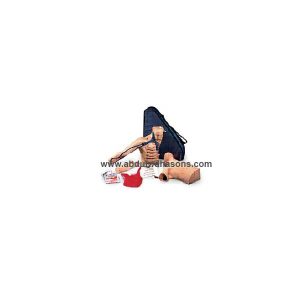
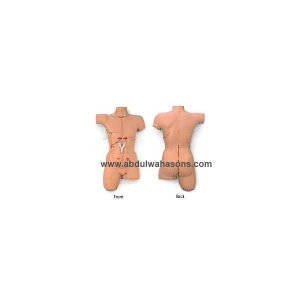
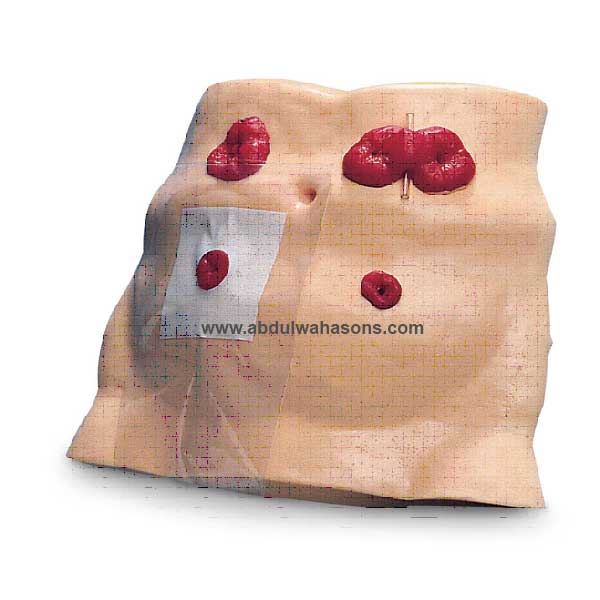
Made of BIOLIKE2™ tissue, this model feels like real flesh. May be washed with soap and water, taped, bandaged, or fitted with ostomy bags. All four stomas may be lubricated and dilated with an inserted finger. 13″ x 18″ x 3″. Includes lubricant, draping sheet, and carrying case.
Related products
-
ZOLL AED Trainer Package with CPR Brad
Product Description
This unit allows students to practice realistic device operation using AHA recommended training scenarios. An identical graphical operator interface and complete audio and visual prompts mimic the AED Plus in its look and operation. Screen messages, audible tones, and voice prompts guide the user through all aspects of the rescue from arrival on scene and calling for help to administering CPR and shock delivery. The convenient handheld remote control for instructor use is preprogrammed with the eight American Heart Association Heartsaver AED training scenarios and offers a manual scenario function, plus attach pads, low battery, and call-for-service simulations. The training unit is powered by six “C” cell batteries (not included) or an AC adapter. Supplied with training electrode kit, training remote control, AC adapter, handheld cord, operator manual, administration guide,. Shipped in two boxes. 28″ x 17″ x 10″, and 17″ x 12″ x 16″.
-
Pediatric Lumbar Puncture Simulator
Product Description
Infants commonly require lumbar puncture as a diagnostic procedure used to collect a sample of cerebrospinal fluid (CSF), measure cerebrospinal fluid pressure, or to inject medications intrathecally. The Life/form® Pediatric Lumbar Puncture Simulator represents a 10-12 month old infant placed in a left lateral decubitus position with the neck and knees flexed, approximating the necessary fetal position. The embedded iliac crest offers exceptional realism, while the removable spine, spinal canal and skin pad make training simple and hassle free. Lumbar puncture may be performed in the L3-L4, L4-L5, or L5-S1 spaces. The correct site can be located by palpating the iliac crest and spine. A small “give” will be felt as the spinal needle is advanced slowly into the proper space. Fluid will flow when the needle is in proper position. Students will appreciate the opportunity to practice this delicate but commonly performed procedure on a simulator that is both appealing and anatomically accurate.
Benefits:
• Targets key skills specific to pediatric lumbar puncture procedures
• Palpation of landmarks
• Skin preparation
• Needle positioning and insertion
• Cerebrospinal fluid collection
• Measure cerebrospinal fluid pressure
• Intrathecal injectionsFeatures:
• Anatomically correct and palpable
• Correct body positioning
• Lumbar pad is easy to replace
• Realistic resistance
• Simulated CSF flows with successful punctureThe Life/form® Pediatric Lumbar Puncture Simulator arrives attached to a board for stability during practice. The infant measures 19″ L x 7″ W x 6″ H and the board measures 19-1/2″ L x 11″ W. Includes the Pediatric Lumbar Puncture Infant on a sturdy board, one lumbar puncture pad with spine and spinal tubing, IV bag with tubing, baby powder, hard carry case, and instruction manual. Fluid supply stand and needle not included.
-
Code Simulator 12-Lead Arrhythmia Simulator – Phillips
Product Description
Pace and defibrillate directly into this interactive 12-lead ECG simulator through your hands-free defibrillation cable.
• Simulate electrical capture with your external pacer. Press simulator capture key to select one of four pre-set pacing capture levels: 70, 80, 90, or 100mA. When pacer current is greater than selected capture level, paced beats appear on your monitor. Waveforms for pacing include: Sinus Brady (two), 1st degree A-V block, 2nd degree type I A-V block, 2nd degree type II A-V block, 2nd degree type II A-V block with PVCs, and 3rd degree A-V block.
• Simulate cardioversion with your manual, semi-automatic, or automatic defibrillator. Activate “convert” feature to select – before defib discharge – another rhythm to run immediately after defib discharge. Waveforms for defibrillator training include: V. Fib., V. Tach (high rate), V. Tach (low rate), Torsade, A. Fib, A. Flutter, PSVT, Sinus Tach, Sinus Rhythm, Sinus Rhythm with PVCs, Asystole, and NSR.
• Generate realistic 12-lead ECG rhythms. Connect your ECG cable to simulator’s 10 ECG snaps. Independent chest lead and limb lead ECG signals create realistic 12-lead ECGs for each rhythm. Generate ST segment and T wave abnormalities including: Anterior MI, Inferior MI, Antero-Septal ST Elevation, Anterior ST Depression, Lateral ST Elevation, and Inferior ST Elevation.
• LED indicators: pacer pulse detection, defib discharge detection, and low battery.

Reviews
There are no reviews yet.