This life-size model shows the five stages of birth: fetus in uterus with os uteri closed, with os uteri open, the beginning of the emergence of the head, the complete emergence of the head, and the placenta in the uterus. Each stage is on a separate base.
Pace and defibrillate directly into this interactive 12-lead ECG simulator through your hands-free defibrillation cable.
 Connects directly to monitor
 • Does not work with manikin
 • Simulate electrical capture with your external pacer. Press simulator capture key to select one of four preset pacing capture levels: 70, 80, 90, or 100mA. When pacer current is greater than selected capture level, paced beats appear on your monitor. Waveforms for pacing include: Sinus Brady (two), 1st degree A-V block, 2nd degree type I A-V block, 2nd degree type II A-V block, 2nd degree type II A-V block with PVCs, and 3rd degree A-V block.
 • Simulate cardioversion with your manual, semi-automatic, or automatic defibrillator. Activate “convert” feature to select - before defib discharge - another rhythm to run immediately after defib discharge. Waveforms for defibrillator training include: V. Fib., V. Tach (high rate), V. Tach (low rate), Torsade, A. Fib, A. Flutter, PSVT, Sinus Tach, Sinus Rhythm, Sinus Rhythm with PVCs, Asystole, and NSR.
 • Generate realistic 12-lead ECG rhythms. Connect your ECG cable to simulator’s 10 ECG snaps. Independent chest lead and limb lead ECG signals create realistic 12-lead ECGs for each rhythm. Generate ST segment and T wave abnormalities including: Anterior MI, Inferior MI, Antero-Septal ST Elevation, Anterior ST Depression, Lateral ST Elevation, and Inferior ST Elevation.
 • LED indicators: pacer pulse detection, defib discharge detection, and low battery.
Pace and defibrillate directly into this interactive 12-lead ECG simulator through your hands-free defibrillation cable.
• Simulate electrical capture with your external pacer. Press simulator capture key to select one of four pre-set pacing capture levels: 70, 80, 90, or 100mA. When pacer current is greater than selected capture level, paced beats appear on your monitor. Waveforms for pacing include: Sinus Brady (two), 1st degree A-V block, 2nd degree type I A-V block, 2nd degree type II A-V block, 2nd degree type II A-V block with PVCs, and 3rd degree A-V block.
• Simulate cardioversion with your manual, semi-automatic, or automatic defibrillator. Activate “convert” feature to select – before defib discharge – another rhythm to run immediately after defib discharge. Waveforms for defibrillator training include: V. Fib., V. Tach (high rate), V. Tach (low rate), Torsade, A. Fib, A. Flutter, PSVT, Sinus Tach, Sinus Rhythm, Sinus Rhythm with PVCs, Asystole, and NSR.
• Generate realistic 12-lead ECG rhythms. Connect your ECG cable to simulator’s 10 ECG snaps. Independent chest lead and limb lead ECG signals create realistic 12-lead ECGs for each rhythm. Generate ST segment and T wave abnormalities including: Anterior MI, Inferior MI, Antero-Septal ST Elevation, Anterior ST Depression, Lateral ST Elevation, and Inferior ST Elevation.
• LED indicators: pacer pulse detection, defib discharge detection, and low battery.
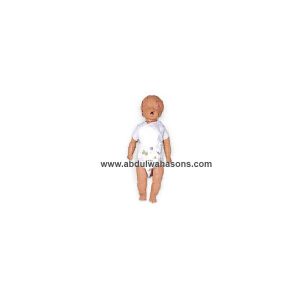
Simulaids original CPR pediatric manikin is air-filled, but can be filled with water to simulate the weight and “feel” of a real newborn. Manikin features realistic chest rise, lifelike rib cage with sternum, xiphoid process, suprasternal notch, and painted nipples for accurate CPR hand placement. Adequate ventilations cause a realistic chest rise. The flow-through design of this manikin allows cleaning and sanitizing without disassembly. Includes soft carry bag, clothing, and 12 disposable lungs. Size: 26″ x 8″ x 8″.
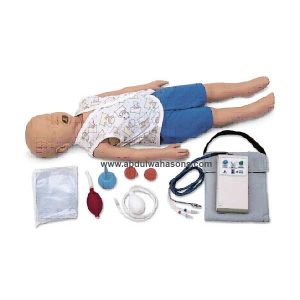
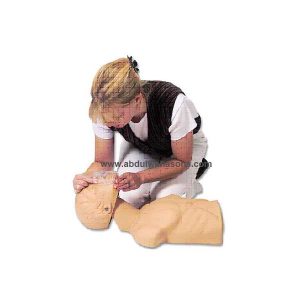
This child CPR manikin can be filled with water to approximate the same weight and “feel” as a real child of corresponding size. Realistic rise and fall of the chest is provided when air enters under the chest overlay. The torso features lifelike rib cage, sternum, xiphoid process, and suprasternal notch to help train effective compression technique. The manikin is designed to sink when filled with water and placed in a pool, and is ideal for water rescue and in-water CPR practice. The manikin is ruggedly designed for effective flow-through cleaning and sanitizing without disassembly. Optional trouble-free electronics housed outside of the manikin offer a unique, patented system for monitoring correct performance during CPR training. Sensors activate lights and/or an audio signal to indicate correct lung ventilation, depth of compression, and correct finger or hand placement. A simulated 3-year-old child complete with three nonrebreathing valves, 12 disposable lungs, and nylon carrying bag. Clothing and bag – Fabric U.S.A.
Designed for needle or surgical cricothyrotomy. Landmarks include thyroid cartilage, cricoid cartilage, and cricoid membrane. Inflation of simulated lung verifies correct placement. Adult and 3-year-old tracheas and soft carry bag included. With four overlay skins. Dimensions: 12″ x 8-1/2″ x 9-1/2″.
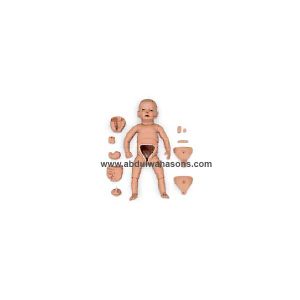
This advanced and incredibly realistic model features internal organs (heart, lung, intestine system, stomach, and bladder), a removable belly covering, interchangeable genital organs, soft ears, and fully movable head, arms, and legs. It allows students to practice both basic and medical infant care such as tracheostomy care, male and female catheterization, insertion of stomach tube, and enema insertion, as well as femoral and gluteal intramuscular and subcutaneous injections. The fontanels can be palpated. Additionally, this model allows practice in dressing; changing; feeding simulation; navel care; mouth, ear, and nose cleaning; insertion of a rectal thermometer; and proper carrying techniques. Baby is 20-1/2″ long and weighs 6.63 lbs. Includes syringe, suction catheter, feeding tube, urinary catheter, urine collection bag, catheter lubricant, and a carrying bag.
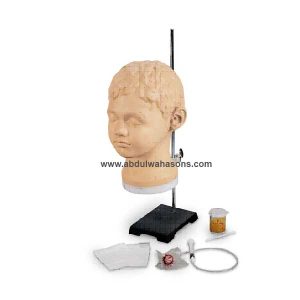
Now with one exciting new trainer, students, residents, and practicing physicians can master the skills needed to examine the human ear using visual cues, correctly diagnose common diseases, clean the ear canal, remove a foreign body, and perform a myringotomy with ear tube insertion. The Life/form® Diagnostic and Procedural Ear Trainer is anatomically correct. Life-like right and left ears teach diagnostic and procedural techniques and are removable for easy maintenance and storage. For the ultimate in realism, the middle ear can be filled with various fluids. The instructor controls the color and consistency of the fluids. Another feature that brings this trainer as close to life as possible is the inclusion of nine diagnostic cartridges with full-color photo prints illustrating:
• Normal tympanic membrane
• Mucoid otitis media
• Serous otitis media with an air-fluid level
• Chronic otitis media with small and large tympanic membrane perforations
• Two views of attic cholesteatoma
• Atelectatic middle ear otitis
• Tympanic sclerosis
Trainer comes complete with two ears, approximately 100 pre-cut eardrums, specially formulated ear wax, three standard middle ear cartridge with syringe, adjustable stand, and a hard carry case. Otoscope, ventilation tubes, and surgical instruments are not provide
The Life/form® Ear Examination Simulator makes it possible to practice examination of the human ear. Specially molded to exactly simulate external and internal physical appearance and dimensions, the plug-in removable ears are easily changed. Life-size full-color prints on film, embedded at the tympanic membrane, provide the same realistic views experienced with a live patient.
The lifelike, flexible texture of the ears requires the same manipulation when using the otoscope as required on a live patient. Realistic irrigation and cleaning exercises are possible with the two tubes of synthetic earwax that are provided with the simulator. A supplementary set of four ears is available separately for advanced nursing and medical school training (see LF01020U).
Includes normal tympanic membrane (photo embedded); mucoid otitis media (photo embedded); serous otitis media with fluid level (photo embedded); chronic otitis media with perforation (photo embedded); normal tympanic membrane with slanted ear canal (photo embedded); normal ear without photo for earwax rmoval exercise; two tubes of synthetic earwax; image CD; instructions; and hard carrying case.
Now with new lifelike skin for the most realistic suturing practice! These new and improved Life/form® Episiotomy Suturing Simulators provide a realistic way for students to learn good surgical techniques. The simulators provide students with a variety of repair experiences without the constraint of time and concern for safety, which are factors with a live patient. The simulators can be used by the student in a learning lab with an instructor, or by the student individually in the clinical setting just prior to a patient experience. They are also useful as homework teaching aids that can be signed out at night and returned the next day. In addition to being portable, the lifelike texture allows the learner to develop a “feel” for instrument handling, tension on suture, and the advantages of one method of tying knots over another.
Includes one of each simulator:
• Midline Suture Simulator (LF00691U)
• Left Mediolateral Suture Simulator (LF00692U)
• Right Mediolateral Suture Simulator (LF00693U)
Each simulator comes with an instruction booklet and is individually boxed.
Now that your students have mastered basic suturing skills on a flat pad, offer them more challenging real-life scenarios with the Life/form® Facial Suturing Module Set. Use these handy portable trainers to help build confidence and technique in the repair of complex lacerations to the mouth, nose, ear and eye. The soft, lifelike skin can be cut and stitched many times, then easily replaced over the permanent core and base. Completely washable and nontoxic. Set includes scalpel, forceps, needle holder and scissors in a soft case, baby powder, and one nylon suture.
Abdul Wahab & Sons provides advanced scientific and medical education solutions, including VR/AR, holograms, 3D Anatomy Tables, and PowerLab systems. AWS serve hospitals, research labs, medical schools, and universities with precision instruments, skill labs, and immersive learning tools empowering the future of healthcare and science.