Episiotomy Suturing Simulators
Product Description
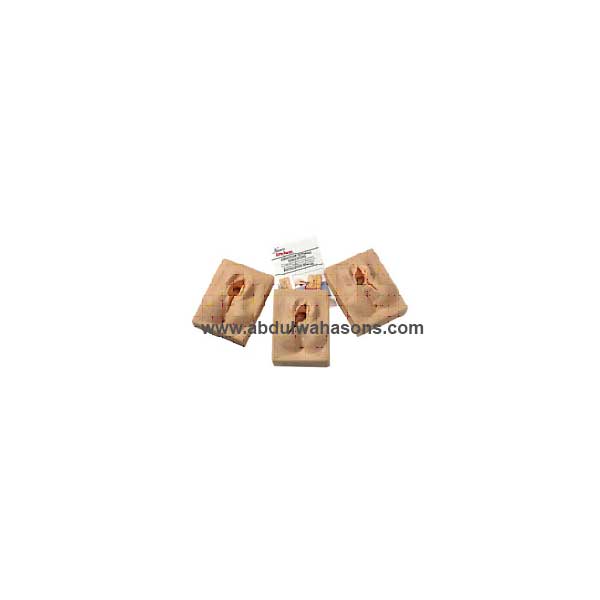
Now with new lifelike skin for the most realistic suturing practice! These new and improved Life/form® Episiotomy Suturing Simulators provide a realistic way for students to learn good surgical techniques. The simulators provide students with a variety of repair experiences without the constraint of time and concern for safety, which are factors with a live patient. The simulators can be used by the student in a learning lab with an instructor, or by the student individually in the clinical setting just prior to a patient experience. They are also useful as homework teaching aids that can be signed out at night and returned the next day. In addition to being portable, the lifelike texture allows the learner to develop a “feel” for instrument handling, tension on suture, and the advantages of one method of tying knots over another.
Includes one of each simulator:
• Midline Suture Simulator (LF00691U)
• Left Mediolateral Suture Simulator (LF00692U)
• Right Mediolateral Suture Simulator (LF00693U)
Each simulator comes with an instruction booklet and is individually boxed.
Related products
-
Code Simulator 12-Lead Arrhythmia Simulator – Phillips
Product Description
Pace and defibrillate directly into this interactive 12-lead ECG simulator through your hands-free defibrillation cable.
• Simulate electrical capture with your external pacer. Press simulator capture key to select one of four pre-set pacing capture levels: 70, 80, 90, or 100mA. When pacer current is greater than selected capture level, paced beats appear on your monitor. Waveforms for pacing include: Sinus Brady (two), 1st degree A-V block, 2nd degree type I A-V block, 2nd degree type II A-V block, 2nd degree type II A-V block with PVCs, and 3rd degree A-V block.
• Simulate cardioversion with your manual, semi-automatic, or automatic defibrillator. Activate “convert” feature to select – before defib discharge – another rhythm to run immediately after defib discharge. Waveforms for defibrillator training include: V. Fib., V. Tach (high rate), V. Tach (low rate), Torsade, A. Fib, A. Flutter, PSVT, Sinus Tach, Sinus Rhythm, Sinus Rhythm with PVCs, Asystole, and NSR.
• Generate realistic 12-lead ECG rhythms. Connect your ECG cable to simulator’s 10 ECG snaps. Independent chest lead and limb lead ECG signals create realistic 12-lead ECGs for each rhythm. Generate ST segment and T wave abnormalities including: Anterior MI, Inferior MI, Antero-Septal ST Elevation, Anterior ST Depression, Lateral ST Elevation, and Inferior ST Elevation.
• LED indicators: pacer pulse detection, defib discharge detection, and low battery. -
Brad and Paul Compact CPR Training Manikins
Three economical CPR manikins are constructed of soft, realistic vinyl plastic over polyurethane foam for a human feel
Features include a large torso for realistic abdominal thrusts, realistic .head lift for opening airway, can easily be manipulated
To realistically simulate airway obstruction or choking situation, and a user-friendly lung/airway design that eliminates cleaning. Includes three mouth/nosepieces and three disposable lung / airway, system.choose either brad (white) or Paul (black) with nylon
Carry bag and kneeling pads .Order with electronic and receive an exterior console box that indicates proper hand position, adequate chest compression, and adequate air volume.
-
Advanced Venipuncture and Injection Arm – Light
Product Description
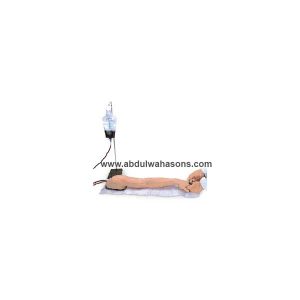
This revolutionary training arm provides complete venous access for IV therapy and phlebotomy, plus sites for intramuscular and intradermal injections. An extensive 8-line vascular system allows students to practice venipuncture at all primary and secondary locations, including starting IVs and introducing Over the Needle IV Catheters. The venous system simplifies setup with only one external fluid bag supplying artificial blood to all veins simultaneously. The dorsal surface of the hand includes injectable metacarpal, digital, and thumb veins. The antecubital fossa includes the median cephalic, median basilic, and median cubital veins. Venipuncture can also be performed along the basilic, cephalic, accessory cephalic, and median antebrachial veins. Intramuscular injections may be performed in the deltoid muscle and intradermal injection sites are located in the upper arm. Intramuscular injections into the deltoid muscle are enhanced by the soft, lifelike skin and by the natural bony landmarks in the region. Intradermal injections using distilled water will create characteristic skin welts at designated sites on the upper arm. The realism of the Life/form® Advanced Venipuncture and Injection Arm is truly amazing. The soft, flexible fingers are molded separately with extreme attention paid to every detail – right down to the fingerprints! Flexion of the wrist helps students develop manipulation skills. The replaceable skin rolls as the veins are palpated, and a discernable “pop” is felt when entering the veins. The Life/form® molding process reproduces the fine details of the skin to make the arm look and feel alive. Valves in the veins can be seen and palpated on the skin surface. Simulated veins and skin are completely replaceable to keep this training arm looking and working like new. Under normal use, hundreds of injections may be performed before the veins or skin need to be replaced. Complete replacement kits are available and easy to use. To extend the life of the veins, an aerosol sealant is available to seal punctures and prevent leakage.
Complete Venous Access:
• Basilic V.
• Cephalic V.
• Digital V.
• Dorsal Metacarpal V.
• Median Basilic V.
• Accessory Cephalic V.
• Extensive Venipuncture System
• Flexible Fingers and Wrist
• Intradermal Injections
• Intramuscular Injections
• Median Antebrachial V.
• Median Cephalic V.
• Median Cubital V.
• Replaceable Skin and Veins -
ZOLL AED Trainer Package with CPR Brad
Product Description
This unit allows students to practice realistic device operation using AHA recommended training scenarios. An identical graphical operator interface and complete audio and visual prompts mimic the AED Plus in its look and operation. Screen messages, audible tones, and voice prompts guide the user through all aspects of the rescue from arrival on scene and calling for help to administering CPR and shock delivery. The convenient handheld remote control for instructor use is preprogrammed with the eight American Heart Association Heartsaver AED training scenarios and offers a manual scenario function, plus attach pads, low battery, and call-for-service simulations. The training unit is powered by six “C” cell batteries (not included) or an AC adapter. Supplied with training electrode kit, training remote control, AC adapter, handheld cord, operator manual, administration guide,. Shipped in two boxes. 28″ x 17″ x 10″, and 17″ x 12″ x 16″.

Reviews
There are no reviews yet.