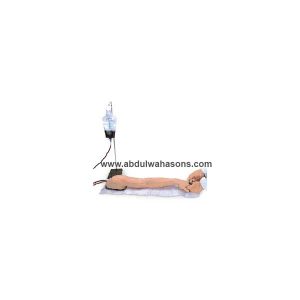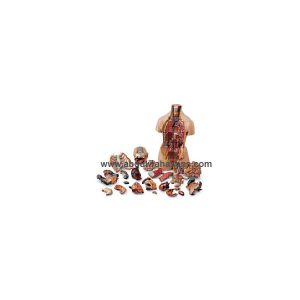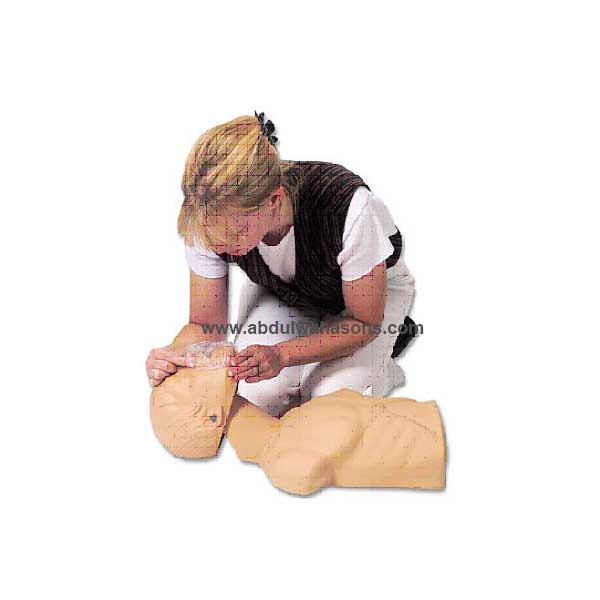
Facial Suturing Module Set
Product Description
Now that your students have mastered basic suturing skills on a flat pad, offer them more challenging real-life scenarios with the Life/form® Facial Suturing Module Set. Use these handy portable trainers to help build confidence and technique in the repair of complex lacerations to the mouth, nose, ear and eye. The soft, lifelike skin can be cut and stitched many times, then easily replaced over the permanent core and base. Completely washable and nontoxic. Set includes scalpel, forceps, needle holder and scissors in a soft case, baby powder, and one nylon suture.
Related products
-
Code Simulator 12-Lead Arrhythmia Simulator – ZOLL
Pace and defibrillate directly into this interactive 12-lead ECG simulator through your hands-free defibrillation cable. Connects directly to monitor • Does not work with manikin • Simulate electrical capture with your external pacer. Press simulator capture key to select one of four preset pacing capture levels: 70, 80, 90, or 100mA. When pacer current is greater than selected capture level, paced beats appear on your monitor. Waveforms for pacing include: Sinus Brady (two), 1st degree A-V block, 2nd degree type I A-V block, 2nd degree type II A-V block, 2nd degree type II A-V block with PVCs, and 3rd degree A-V block. • Simulate cardioversion with your manual, semi-automatic, or automatic defibrillator. Activate “convert” feature to select - before defib discharge - another rhythm to run immediately after defib discharge. Waveforms for defibrillator training include: V. Fib., V. Tach (high rate), V. Tach (low rate), Torsade, A. Fib, A. Flutter, PSVT, Sinus Tach, Sinus Rhythm, Sinus Rhythm with PVCs, Asystole, and NSR. • Generate realistic 12-lead ECG rhythms. Connect your ECG cable to simulator’s 10 ECG snaps. Independent chest lead and limb lead ECG signals create realistic 12-lead ECGs for each rhythm. Generate ST segment and T wave abnormalities including: Anterior MI, Inferior MI, Antero-Septal ST Elevation, Anterior ST Depression, Lateral ST Elevation, and Inferior ST Elevation. • LED indicators: pacer pulse detection, defib discharge detection, and low battery.
-
STAT Baby
Product Description
Realism in pediatric training that is also affordable. STAT Baby brings you the most lifelike simulator for infant care by utilizing new material for tactile awareness during assessment. Developed in conjunction with leading pediatric physician involvement, this baby contains a wide range of skill sets in a simple format. The infant is sized to a 9-months-old and weighs 18 lbs. The size, heft, and feel of this child stirs the emotions when you pick it up.
Features:
Bilateral chest tube insertion
Defibrillation with shock level of 2-4 joules per kg
ET Tube insertion
Feeding tube care
Foley catheter insertion (female)
Intramuscular and subcutaneous injection sites
Intraosseous leg
LMA insertion
NG tube placement with fluid reservoir
Peripheral IV sites on hand foot
PICC line
Pneumothorax
Rectal medication
Six pulse locations
Tongue edema and laryngospasm
Trachea care
The STAT Baby is supplied with accessories that include IV vein kit ( one arm and one leg ) leg skin, arm skin, 121/0 leg bones, four pneumothorax sites, two injection sites, one PICC line site, four bags, defibrillator adapter, interactive ECG simulator, simulated blood powder, and carry bag. Wt.28lbs.
-
Peter PICC Line
Product Description
The only available teaching model which permits the practice of placing Peripherally Inserted Central Catheter Lines (PICC Lines). The rapid acceptance and use of PICC Lines creates a need to be able to properly teach this procedure. Peter PICC Line™ allows both the teaching and assessment of this insertion technique. This portable teaching model has translucent arm skin that allows the visualization of the anatomically correct cephalic, basilic, and median basilic veins. The axillary jugular, subclavian, and superior vena cava veins are also present, plus a movable chin simulates the occlusion of the jugular to prevent the PICC Line from taking this path. Palpable ribs permit practice in measuring proper catheter length to the correct intercostal space. The model also permits the measurement of catheter length outside of the body and the confirmation of proper placement by viewing the distal tip of the catheter in the viewable superior vena cava. Replaceable, barely translucent arm skin allows visualization of underlying veins. Includes soft carrying case. A great tool for training and skill assessment. Blue veins are made of natural latex. Measures 17″ x 22″ x 5-1.2″.
-
NG Tube & Trach Skills Simulator
Product Description
The Life/form® NG Tube & Trach Skills Simulator has been developed to aid with the instruction, training, and practice of vital tracheostomy skills and care for patients with respiratory conditions. The simulator is also designed for instruction of gastrointestinal care procedures through nasal and oral access. With a newly designed Life/form® head and torso, this simulator features realistic landmarks, trachea, esophagus, lungs, and stomach. For exceptional realism, methyl cellulose can be mixed with water to simulate mucous-like fluids of a real patient. Fluid can be added to the lungs and stomach for realistic tracheostomy care and suctioning. The simulator also allows for the practice of dressing changes and cuff inflation. Other realistic procedures include: NG tube care, including insertion, irrigation, and removal; gastric lavage and gavage; feeding tube insertion and removal with the ability to practice feeding; nasoenteric and esophageal tube care; oropharyngeal and nasopharyngeal care; and tracheostomy tube care Intubation using a laryngoscope blade and size 6.0 ET tube may also be practiced. The simulator is designed to use size 6 tracheostomy tubes (LF01170U) and a size 6 NG tube. Spray-pump lubricant, a packet of methyl cellulose, instruction manual, and hard carry case are included. The simulator does not include tracheostomy ET, or NG tube. 10″ D x 16″ W x 27 H.

Reviews
There are no reviews yet.