Multipurpose Patient Care and CPR Pediatric Simulator – Five-Year Old Manikin
Product Description
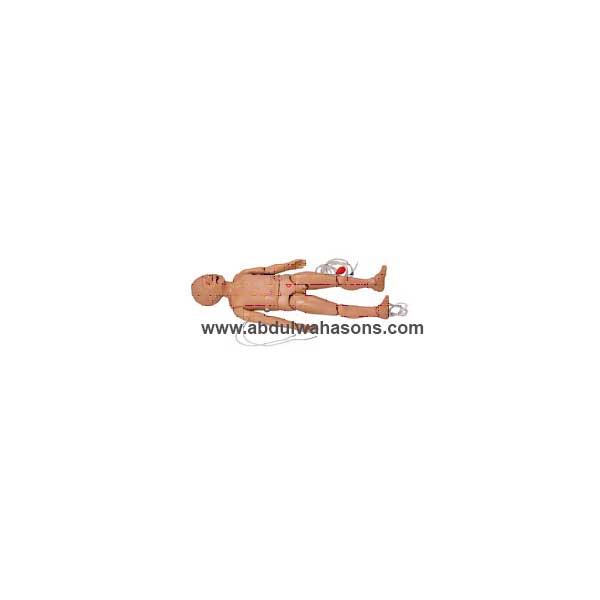
A realistic simulator for student practice of pediatric patient care techniques. Features include articulating head, jaw, arms, and legs; eye irrigation; oral, nasal, and digital intubation; place OP/NP tubes; right/left main stem bronchi; place nasal and oral gastric tubes; suctioning; BVM; chest compression/rise; lavage/gavage; G-tube placement; stomas for ileostomy, colostomy, and suprapubic exercises; intraosseous infusion; IV arm with variable, palpable pulses; male/female catheterization; and placement of rectal suppositories.
Related products
-
Code Simulator 12-Lead Arrhythmia Simulator – Phillips
Product Description
Pace and defibrillate directly into this interactive 12-lead ECG simulator through your hands-free defibrillation cable.
• Simulate electrical capture with your external pacer. Press simulator capture key to select one of four pre-set pacing capture levels: 70, 80, 90, or 100mA. When pacer current is greater than selected capture level, paced beats appear on your monitor. Waveforms for pacing include: Sinus Brady (two), 1st degree A-V block, 2nd degree type I A-V block, 2nd degree type II A-V block, 2nd degree type II A-V block with PVCs, and 3rd degree A-V block.
• Simulate cardioversion with your manual, semi-automatic, or automatic defibrillator. Activate “convert” feature to select – before defib discharge – another rhythm to run immediately after defib discharge. Waveforms for defibrillator training include: V. Fib., V. Tach (high rate), V. Tach (low rate), Torsade, A. Fib, A. Flutter, PSVT, Sinus Tach, Sinus Rhythm, Sinus Rhythm with PVCs, Asystole, and NSR.
• Generate realistic 12-lead ECG rhythms. Connect your ECG cable to simulator’s 10 ECG snaps. Independent chest lead and limb lead ECG signals create realistic 12-lead ECGs for each rhythm. Generate ST segment and T wave abnormalities including: Anterior MI, Inferior MI, Antero-Septal ST Elevation, Anterior ST Depression, Lateral ST Elevation, and Inferior ST Elevation.
• LED indicators: pacer pulse detection, defib discharge detection, and low battery. -
Pediatric Lumbar Puncture Simulator
Product Description
Infants commonly require lumbar puncture as a diagnostic procedure used to collect a sample of cerebrospinal fluid (CSF), measure cerebrospinal fluid pressure, or to inject medications intrathecally. The Life/form® Pediatric Lumbar Puncture Simulator represents a 10-12 month old infant placed in a left lateral decubitus position with the neck and knees flexed, approximating the necessary fetal position. The embedded iliac crest offers exceptional realism, while the removable spine, spinal canal and skin pad make training simple and hassle free. Lumbar puncture may be performed in the L3-L4, L4-L5, or L5-S1 spaces. The correct site can be located by palpating the iliac crest and spine. A small “give” will be felt as the spinal needle is advanced slowly into the proper space. Fluid will flow when the needle is in proper position. Students will appreciate the opportunity to practice this delicate but commonly performed procedure on a simulator that is both appealing and anatomically accurate.
Benefits:
• Targets key skills specific to pediatric lumbar puncture procedures
• Palpation of landmarks
• Skin preparation
• Needle positioning and insertion
• Cerebrospinal fluid collection
• Measure cerebrospinal fluid pressure
• Intrathecal injectionsFeatures:
• Anatomically correct and palpable
• Correct body positioning
• Lumbar pad is easy to replace
• Realistic resistance
• Simulated CSF flows with successful punctureThe Life/form® Pediatric Lumbar Puncture Simulator arrives attached to a board for stability during practice. The infant measures 19″ L x 7″ W x 6″ H and the board measures 19-1/2″ L x 11″ W. Includes the Pediatric Lumbar Puncture Infant on a sturdy board, one lumbar puncture pad with spine and spinal tubing, IV bag with tubing, baby powder, hard carry case, and instruction manual. Fluid supply stand and needle not included.
-
Auscultation Manikin with ECG Simulator
Product Description
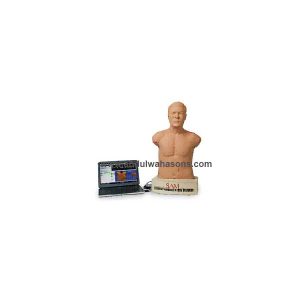
Manikin has all the same features as the complete CRiSis™ Manikin (LF03953U with the addition of auscultation sites with heart and lung sounds, plus an ECG Simulator LF03670U). For auscultation training, the instructor selects from a menu of heart and lung conditions by wireless remote control. The manikin presents itself as a real patient without visible auscultation sites. The student must palpate to identify correct auscultation locations, and will hear different heart and lung sounds as the SmartScope™ is moved to different locations on the manikin. A diagnosis of the condition selected by the instructor can be made by comparing the variations in sounds occurring at different sites – just like a real patient! Lung sounds can be detected at five anterior and two midaxillary locations and students can practice auscultation at six anterior heart sites. The remote control does not have to be pointed directly at the manikin or SmartScope™ to operate. One remote control will operate multiple sets of SmartScopes™ and manikins simultaneously. Great for group instruction. Listen to the sounds by using either the single or dual user headpieces on SmartScope™ or by connecting to an amplified speaker (not included, see SB20146U). Range on the unit is up to 100 ft. of remote access. Adult CRiSis™ Auscultation Manikin includes Complete CRiSis™ Manikin with auscultation sites, one remote control with LCD display, one SmartScope™ with single- and dual-user headpieces, hard storage case, and ECG Simulator (LF03670U). Requires two “AA” and two “AAA” batteries (included).
Lung Conditions:
• Bronchial
• Bronchovesicular
• Cavernous
• Coarse Crackle
• Egophony
• Fine Crackle
• Friction Rub
• Infant
• Mono Wheeze
• Normal
• Normal Vesicular
• Pectoriloquy
• Pulmonary Edema
• Rhonchi
• Stridor
• WheezeHeart Conditions:
• Aortic Regurgitation
• Atrial Septal Defect
• Holosystolic
• Mid Systolic
• Mitral Stenosis
• Normal
• PDA
• Pulmonary Stenosis
• Systolic Click
• S3 and S4 Gallup
• VSD

Reviews
There are no reviews yet.