Breast Self-Examination Simulator
Product Description
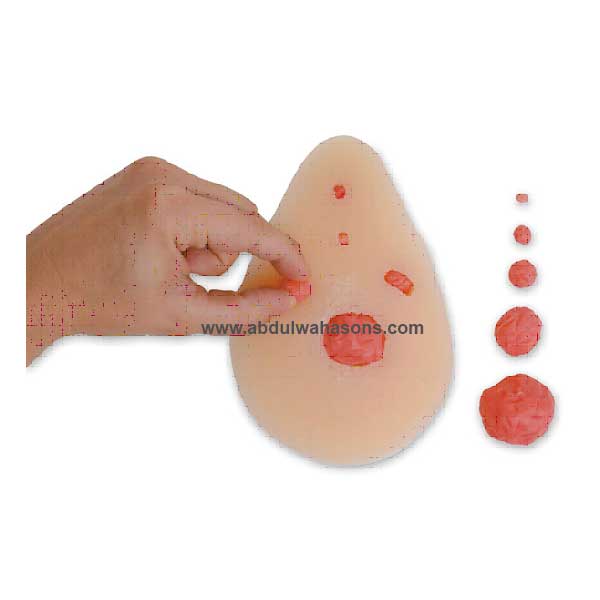
This simulator combines state&-of-the-art materials to create a realistic look, feel, and texture. An excellent platform to teach how to perform breast examinations as well as demonstrate self-examination techniques. Left breast contains four masses in the breast tissue and two masses in the axilla region. The masses range in size from 14 mm to 19 mm, and their depths range from 6 mm to 16 mm. Right breast contains two masses designed to simulate an enlarged axillary lymph node and two fluid-filled cysts (19 mm and 24 mm). Includes user guide, a Breast Examination Learning Package CD, and carry case.

Related products
-
Code Simulator 12-Lead Arrhythmia Simulator – Phillips
Product Description
Pace and defibrillate directly into this interactive 12-lead ECG simulator through your hands-free defibrillation cable.
• Simulate electrical capture with your external pacer. Press simulator capture key to select one of four pre-set pacing capture levels: 70, 80, 90, or 100mA. When pacer current is greater than selected capture level, paced beats appear on your monitor. Waveforms for pacing include: Sinus Brady (two), 1st degree A-V block, 2nd degree type I A-V block, 2nd degree type II A-V block, 2nd degree type II A-V block with PVCs, and 3rd degree A-V block.
• Simulate cardioversion with your manual, semi-automatic, or automatic defibrillator. Activate “convert” feature to select – before defib discharge – another rhythm to run immediately after defib discharge. Waveforms for defibrillator training include: V. Fib., V. Tach (high rate), V. Tach (low rate), Torsade, A. Fib, A. Flutter, PSVT, Sinus Tach, Sinus Rhythm, Sinus Rhythm with PVCs, Asystole, and NSR.
• Generate realistic 12-lead ECG rhythms. Connect your ECG cable to simulator’s 10 ECG snaps. Independent chest lead and limb lead ECG signals create realistic 12-lead ECGs for each rhythm. Generate ST segment and T wave abnormalities including: Anterior MI, Inferior MI, Antero-Septal ST Elevation, Anterior ST Depression, Lateral ST Elevation, and Inferior ST Elevation.
• LED indicators: pacer pulse detection, defib discharge detection, and low battery. -
Deluxe Nurse Training Baby – Newborn
Product Description
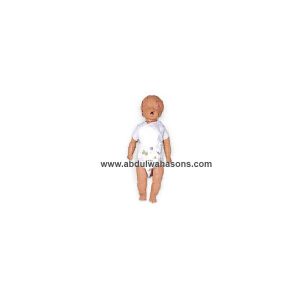
This advanced and incredibly realistic model features internal organs (heart, lung, intestine system, stomach, and bladder), a removable belly covering, interchangeable genital organs, soft ears, and fully movable head, arms, and legs. It allows students to practice both basic and medical infant care such as tracheostomy care, male and female catheterization, insertion of stomach tube, and enema insertion, as well as femoral and gluteal intramuscular and subcutaneous injections. The fontanels can be palpated. Additionally, this model allows practice in dressing; changing; feeding simulation; navel care; mouth, ear, and nose cleaning; insertion of a rectal thermometer; and proper carrying techniques. Baby is 20-1/2″ long and weighs 6.63 lbs. Includes syringe, suction catheter, feeding tube, urinary catheter, urine collection bag, catheter lubricant, and a carrying bag.
-
AED Practi-Trainer – Bilingual
Product Description
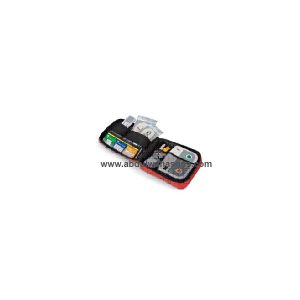
This new and improved AED trainer with plug-in module has all the functions needed to teach students about AED operation – without breaking your equipment budget. This lightweight, value-priced trainer offers bilingual scenarios (English and Spanish), a fully functional remote control, volume adjustment and pause functions, adult and child connectors, and pads. Includes eight pre-programmed scenarios to simulate various cardiac arrest cases. Audible metronome paces CPR chest compressions. Audio port allows you to connect speakers so the entire class can hear scenarios as they play out – extending training even while they wait. Plug-in design allows for easy upgrades and language changes. Comes in a 10-1/2″ x 8″ x 2-3/4″ nylon carrying case. Base requires three “AA” batteries (not included). Remote control requires two “AAA” batteries (not included). AED trainer measures 7″ x 5-3/4″ x 2″. Meets 2005 ECC guidelines. against defects.
-
Code Simulator 12-Lead Arrhythmia Simulator – ZOLL
Pace and defibrillate directly into this interactive 12-lead ECG simulator through your hands-free defibrillation cable. Connects directly to monitor • Does not work with manikin • Simulate electrical capture with your external pacer. Press simulator capture key to select one of four preset pacing capture levels: 70, 80, 90, or 100mA. When pacer current is greater than selected capture level, paced beats appear on your monitor. Waveforms for pacing include: Sinus Brady (two), 1st degree A-V block, 2nd degree type I A-V block, 2nd degree type II A-V block, 2nd degree type II A-V block with PVCs, and 3rd degree A-V block. • Simulate cardioversion with your manual, semi-automatic, or automatic defibrillator. Activate “convert” feature to select - before defib discharge - another rhythm to run immediately after defib discharge. Waveforms for defibrillator training include: V. Fib., V. Tach (high rate), V. Tach (low rate), Torsade, A. Fib, A. Flutter, PSVT, Sinus Tach, Sinus Rhythm, Sinus Rhythm with PVCs, Asystole, and NSR. • Generate realistic 12-lead ECG rhythms. Connect your ECG cable to simulator’s 10 ECG snaps. Independent chest lead and limb lead ECG signals create realistic 12-lead ECGs for each rhythm. Generate ST segment and T wave abnormalities including: Anterior MI, Inferior MI, Antero-Septal ST Elevation, Anterior ST Depression, Lateral ST Elevation, and Inferior ST Elevation. • LED indicators: pacer pulse detection, defib discharge detection, and low battery.

Reviews
There are no reviews yet.