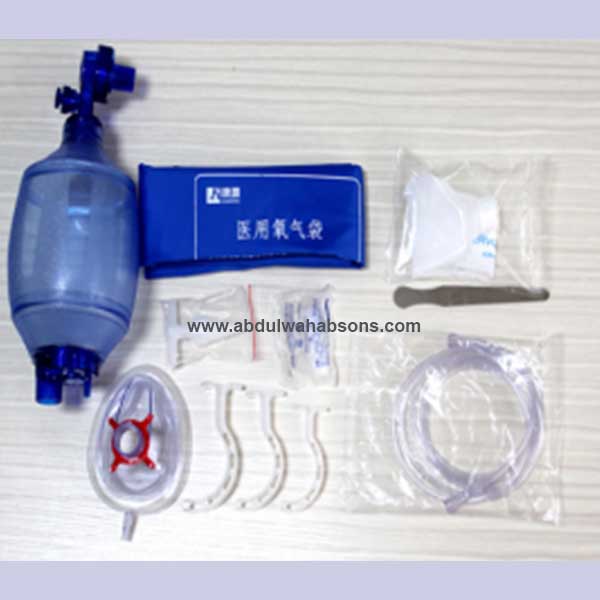
Textured PVC bag for sure grip and comfort. Clear, flexible PVC cushion face mask ensures tight seal. Non-rebreathing valve directs exhaled gas away from care giver. Includes medication/manometer port for use with MDI or syringe, an integrated PEEP connection, and a swivel patient connection. Collapsible. Latex-free. Meets ASTM and ISO standards.
Pace and defibrillate directly into this interactive 12-lead ECG simulator through your hands-free defibrillation cable.
• Simulate electrical capture with your external pacer. Press simulator capture key to select one of four pre-set pacing capture levels: 70, 80, 90, or 100mA. When pacer current is greater than selected capture level, paced beats appear on your monitor. Waveforms for pacing include: Sinus Brady (two), 1st degree A-V block, 2nd degree type I A-V block, 2nd degree type II A-V block, 2nd degree type II A-V block with PVCs, and 3rd degree A-V block.
• Simulate cardioversion with your manual, semi-automatic, or automatic defibrillator. Activate “convert” feature to select – before defib discharge – another rhythm to run immediately after defib discharge. Waveforms for defibrillator training include: V. Fib., V. Tach (high rate), V. Tach (low rate), Torsade, A. Fib, A. Flutter, PSVT, Sinus Tach, Sinus Rhythm, Sinus Rhythm with PVCs, Asystole, and NSR.
• Generate realistic 12-lead ECG rhythms. Connect your ECG cable to simulator’s 10 ECG snaps. Independent chest lead and limb lead ECG signals create realistic 12-lead ECGs for each rhythm. Generate ST segment and T wave abnormalities including: Anterior MI, Inferior MI, Antero-Septal ST Elevation, Anterior ST Depression, Lateral ST Elevation, and Inferior ST Elevation.
• LED indicators: pacer pulse detection, defib discharge detection, and low battery.
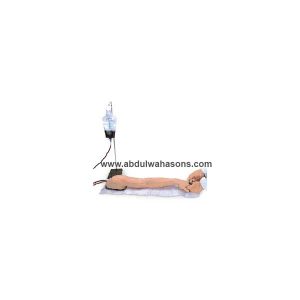
This revolutionary training arm provides complete venous access for IV therapy and phlebotomy, plus sites for intramuscular and intradermal injections. An extensive 8-line vascular system allows students to practice venipuncture at all primary and secondary locations, including starting IVs and introducing Over the Needle IV Catheters. The venous system simplifies setup with only one external fluid bag supplying artificial blood to all veins simultaneously. The dorsal surface of the hand includes injectable metacarpal, digital, and thumb veins. The antecubital fossa includes the median cephalic, median basilic, and median cubital veins. Venipuncture can also be performed along the basilic, cephalic, accessory cephalic, and median antebrachial veins. Intramuscular injections may be performed in the deltoid muscle and intradermal injection sites are located in the upper arm. Intramuscular injections into the deltoid muscle are enhanced by the soft, lifelike skin and by the natural bony landmarks in the region. Intradermal injections using distilled water will create characteristic skin welts at designated sites on the upper arm. The realism of the Life/form® Advanced Venipuncture and Injection Arm is truly amazing. The soft, flexible fingers are molded separately with extreme attention paid to every detail – right down to the fingerprints! Flexion of the wrist helps students develop manipulation skills. The replaceable skin rolls as the veins are palpated, and a discernable “pop” is felt when entering the veins. The Life/form® molding process reproduces the fine details of the skin to make the arm look and feel alive. Valves in the veins can be seen and palpated on the skin surface. Simulated veins and skin are completely replaceable to keep this training arm looking and working like new. Under normal use, hundreds of injections may be performed before the veins or skin need to be replaced. Complete replacement kits are available and easy to use. To extend the life of the veins, an aerosol sealant is available to seal punctures and prevent leakage.
Complete Venous Access:
• Basilic V.
• Cephalic V.
• Digital V.
• Dorsal Metacarpal V.
• Median Basilic V.
• Accessory Cephalic V.
• Extensive Venipuncture System
• Flexible Fingers and Wrist
• Intradermal Injections
• Intramuscular Injections
• Median Antebrachial V.
• Median Cephalic V.
• Median Cubital V.
• Replaceable Skin and Veins
Pace and defibrillate directly into this interactive 12-lead ECG simulator through your hands-free defibrillation cable.
 Connects directly to monitor
 • Does not work with manikin
 • Simulate electrical capture with your external pacer. Press simulator capture key to select one of four preset pacing capture levels: 70, 80, 90, or 100mA. When pacer current is greater than selected capture level, paced beats appear on your monitor. Waveforms for pacing include: Sinus Brady (two), 1st degree A-V block, 2nd degree type I A-V block, 2nd degree type II A-V block, 2nd degree type II A-V block with PVCs, and 3rd degree A-V block.
 • Simulate cardioversion with your manual, semi-automatic, or automatic defibrillator. Activate “convert” feature to select - before defib discharge - another rhythm to run immediately after defib discharge. Waveforms for defibrillator training include: V. Fib., V. Tach (high rate), V. Tach (low rate), Torsade, A. Fib, A. Flutter, PSVT, Sinus Tach, Sinus Rhythm, Sinus Rhythm with PVCs, Asystole, and NSR.
 • Generate realistic 12-lead ECG rhythms. Connect your ECG cable to simulator’s 10 ECG snaps. Independent chest lead and limb lead ECG signals create realistic 12-lead ECGs for each rhythm. Generate ST segment and T wave abnormalities including: Anterior MI, Inferior MI, Antero-Septal ST Elevation, Anterior ST Depression, Lateral ST Elevation, and Inferior ST Elevation.
 • LED indicators: pacer pulse detection, defib discharge detection, and low battery.
Abdul Wahab & Sons provides advanced scientific and medical education solutions, including VR/AR, holograms, 3D Anatomy Tables, and PowerLab systems. AWS serve hospitals, research labs, medical schools, and universities with precision instruments, skill labs, and immersive learning tools empowering the future of healthcare and science.


Reviews
There are no reviews yet.