Adult ALS Trainer
Product Description
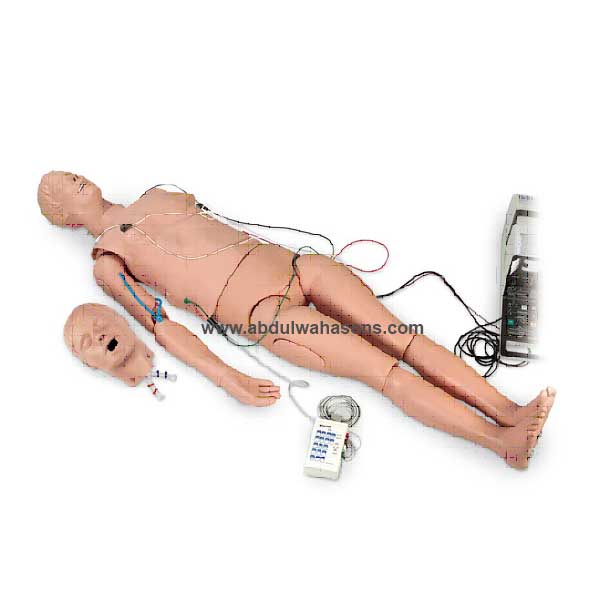
Anatomical landmarks include the sternum, rib cage, and substernal notch. The trainer contains teeth, uvula, vocal cords, glottis, epiglottis, larynx, arytenoid cartilage, trachea, esophagus, and inflatable lungs and stomach. Accepts Combitude®, E.O.A., E.G.T.A., and P.T.L. airways. Additional features include oral and nasal airways for intubation, bag valve mask ventilation, delivery of supplemental oxygen, palpation of carotid pulse, ABC assessment, separate right and left lungs, auscultation of breath sounds, chest compressions and precordial thump, jaw thrust, IV sites in hand and arm for venipuncture, intramuscular injection site, and blood pressure cuff placement. The ECG simulator recreates 17 adult heart rhythms and 17 pediatric rhythms. With an external pacer, you can simulate electronic capture. You can also simulate cardioversion with manual, semiautomatic, or automatic defibrillation. See page 90 for full details of the ECG simulator (LF03670U) included with this manikin. Comes with additional intubation head and soft carry bag. (Left arm not included.) 50 face shield bags.
Related products
-
Peter PICC Line
Product Description
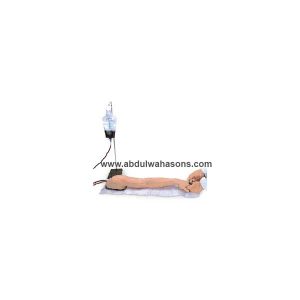
The only available teaching model which permits the practice of placing Peripherally Inserted Central Catheter Lines (PICC Lines). The rapid acceptance and use of PICC Lines creates a need to be able to properly teach this procedure. Peter PICC Line™ allows both the teaching and assessment of this insertion technique. This portable teaching model has translucent arm skin that allows the visualization of the anatomically correct cephalic, basilic, and median basilic veins. The axillary jugular, subclavian, and superior vena cava veins are also present, plus a movable chin simulates the occlusion of the jugular to prevent the PICC Line from taking this path. Palpable ribs permit practice in measuring proper catheter length to the correct intercostal space. The model also permits the measurement of catheter length outside of the body and the confirmation of proper placement by viewing the distal tip of the catheter in the viewable superior vena cava. Replaceable, barely translucent arm skin allows visualization of underlying veins. Includes soft carrying case. A great tool for training and skill assessment. Blue veins are made of natural latex. Measures 17″ x 22″ x 5-1.2″.
-
NG Tube & Trach Skills Simulator
Product Description
The Life/form® NG Tube & Trach Skills Simulator has been developed to aid with the instruction, training, and practice of vital tracheostomy skills and care for patients with respiratory conditions. The simulator is also designed for instruction of gastrointestinal care procedures through nasal and oral access. With a newly designed Life/form® head and torso, this simulator features realistic landmarks, trachea, esophagus, lungs, and stomach. For exceptional realism, methyl cellulose can be mixed with water to simulate mucous-like fluids of a real patient. Fluid can be added to the lungs and stomach for realistic tracheostomy care and suctioning. The simulator also allows for the practice of dressing changes and cuff inflation. Other realistic procedures include: NG tube care, including insertion, irrigation, and removal; gastric lavage and gavage; feeding tube insertion and removal with the ability to practice feeding; nasoenteric and esophageal tube care; oropharyngeal and nasopharyngeal care; and tracheostomy tube care Intubation using a laryngoscope blade and size 6.0 ET tube may also be practiced. The simulator is designed to use size 6 tracheostomy tubes (LF01170U) and a size 6 NG tube. Spray-pump lubricant, a packet of methyl cellulose, instruction manual, and hard carry case are included. The simulator does not include tracheostomy ET, or NG tube. 10″ D x 16″ W x 27 H.
-
Deluxe Nurse Training Baby – Newborn
Product Description
This advanced and incredibly realistic model features internal organs (heart, lung, intestine system, stomach, and bladder), a removable belly covering, interchangeable genital organs, soft ears, and fully movable head, arms, and legs. It allows students to practice both basic and medical infant care such as tracheostomy care, male and female catheterization, insertion of stomach tube, and enema insertion, as well as femoral and gluteal intramuscular and subcutaneous injections. The fontanels can be palpated. Additionally, this model allows practice in dressing; changing; feeding simulation; navel care; mouth, ear, and nose cleaning; insertion of a rectal thermometer; and proper carrying techniques. Baby is 20-1/2″ long and weighs 6.63 lbs. Includes syringe, suction catheter, feeding tube, urinary catheter, urine collection bag, catheter lubricant, and a carrying bag.
-
SMART STAT Basic with iPad
Product Description
This affordable patient simulator takes ALS training into the students’ environment. Instructors can evaluate student knowledge, skill levels, and critical thinking abilities by utilizing the applications via the iPad®*. This simulator can function in the lab and in the field for ascertaining diagnostic ability. Student performance records can be transferred to a computer, and chronological scenario event logs can be printed. SMART STAT Basic has an on-board air compressor, includes a free app on the iTunes Store®* (SMART STAT), storage for students’ performances, spontaneous breathing, pulses, blood pressure, carotid and femoral pulses, normal and emergent heart and lung sounds, 12 pulse points synchronized with the heart, EKG interpretation and cardiac treatment, IV catheterization and infusion, tension pneumothorax treatment, chest tube insertion with simulated drainage, and advanced difficult airway maintenance. Comes with an iPad®*, USB cable, blood pressure cuff, hard carry case, shorts, and a supply of replacement parts.
Advanced Airway Management
• STAT Deluxe Airway Management Head
• Tongue edema
• Laryngospasm
• Cricothyrotomy
• Breakout teeth
• Designed for LT, ET, LMA, and Combitube
ECG
• 4-lead recognition of 17 rhythms
• Defibrillation and cardio conversion
• Variable rates
• Pacing
Emergent Lung Sounds (anterior and posterior)
Emergent Heart Sounds
BP Arm
• Independently vary systolic and diastolic pressures
• Korotkoff sound changes
• Vary the amplitude of the sound
Pulse Points
• 12 locations in pairs: carotid, femoral, popliteal, pedal (dorsal arch), radial, brachial (IV arm-antecubital, BP arm biceps pressure point)
• Distal pulses drop off under 70 mm Hg systolic
• Vary according to ECG rhythm
Bilateral Chest Decompression
• Right- or left-sided, partial or complete pneumothorax
• Audible air discharge upon proper catheterization; no repair necessary
Bilateral Chest Tube Insertion
• Auxiliary fluid bag allows for simulated discharge
• Practice maintenance
Virtual Capnography and Oximetry
Printable Chronological Student Session Reports & Scenarios
• Easy to establish
• Start up library includes samples
• Print out for convenience
Replacement Parts Included
• 10 neck skins
• 4 IM injection pads
• 6 pneumothorax pads
• 3 sets of teeth
• IV vein kit

Reviews
There are no reviews yet.