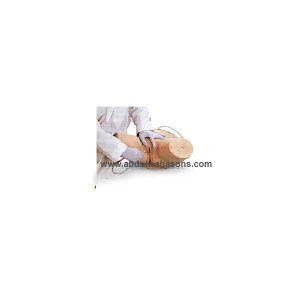
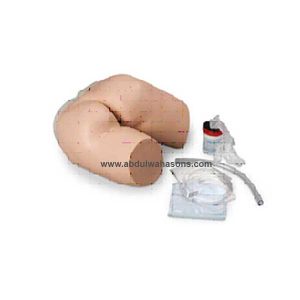
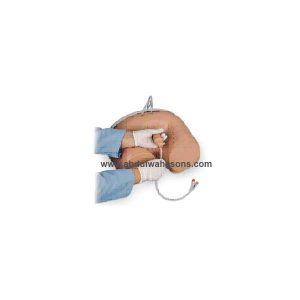
Catheterization is one of the basic skills all nursing students must learn, and to learn the techniques, they must practice. Any patient volunteers? Not likely! But Life/form® simulators allow demonstration and practice in urinary catheterization without embarrassment or discomfort to the patient or the students. In addition, catheterization simulators are useful for anatomical identification and demonstration of perineal care. The Life/form® Female Catheterization Simulator is constructed with a bladder reservoir, patient urethra, and a valve simulating the internal urethral sphincter. The normal feeling of resistance and pressure will be experienced as a catheter is passed through the urethra, past the sphincter, and into the bladder. When the catheter enters the bladder, artificial urine (water) will flow from the catheter just as in a real patient, and the cuff must be completely deflated before the catheter is removed. Improper use of a Foley can result in damage to the simulator. This simulator is the torso of a middle-aged woman with thighs abducted for proper position during catheterization. The external genitalia and perineum are molded in lifelike form. The labia minora can be spread apart naturally to reveal the clitoris, urethral opening, and vaginal introitus. Includes a hard carry case, lubricant, catheter, and teaching guide. Fluid supply stand not included.. Carton size: 24″ x 16″ x 13″.
*NOTE: A Fr. Silicone Foley catheter can be used if extreme care is taken to inflate the cuff only when it is in the proper position. Just as in a real patient, the cuff must be completely deflated before the catheter is removed. Improper use of a Foley can result in damage to the simulator, just as when using a Foley catheter with a real patient.
A life-size human torso with interchangeable male and female genital organs with embryo in third month of pregnancy. Dissectible into 24 parts: head, half brain with arteries, eye with optic nerve, female breast cover, two lung halves, heart (2 parts), stomach (2 parts), liver with gallbladder, large intestine with appendix flap (3 parts), small intestine, kidney half, female genital organs (2 parts) with third month embryo, male genital organs (4 parts), and torso. Unbreakable plastic. 15″ x 10″ x 34″ mounted on base. Torso teaching guide included
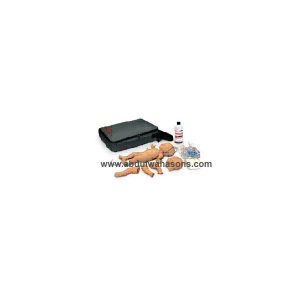
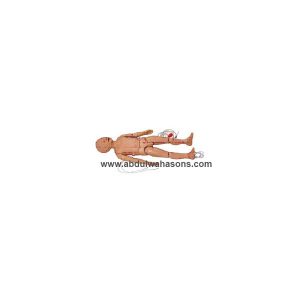
A unique, anatomically correct representation of a 4-lb., 16″ female baby developed to teach and practice the vascular accessing of newborns and infants. Practice accessing, securing, dressing, site care, and maintenance for standard venipuncture, central catheters, PICC lines, and umbilical 5 FR catheters.
• Access the median basilic and axillary veins on the right and left arm
• Right leg – saphenous and popliteal veins
• Neck and head – external jugular and temporal (scalp) veins
• Realistic flashback of simulated “blood” confirms proper needle location in the vein
• Redesigned umbilicus allows repeated catheterization of the umbilical catheter, with proper placement verified by a blood return
• Nasal and oral openings allow placement of nasal cannulas, as well as endotracheal, nasogastric, and feeding tubes to teach suctioning, securing, dressing, cleansing, care, and maintenance
Nita Newborn™ includes female baby body; umbilicus; translucent skin on arm, leg, and head; I.D. bracelet; diaper; vein tubing with umbilical valve; blood reservoir bag with attached tubing; blood concentrate; instruction manual; and carry case.
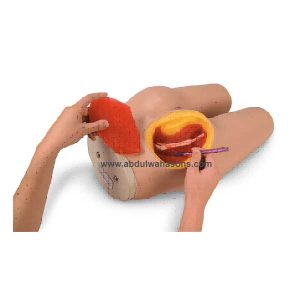
Here is the perfect volunteer for training your beginning healthcare students to administer intramuscular injections. Always available for class demonstrations or practice by groups of any size, the Life/form® Intramuscular Injection Simulator offers both visual and tactile learning. A simulated bony structure is embedded in the torso and represents the superior end of the femur, or greater trochanter, the posterior superior and anterior superior iliac spines, and the sacrum. The bony structure provides palpable anatomical landmarks so students can identify proper injection sites. A section of the upper, outer quadrant of the left gluteal area is cut away to allow students to visualize the underlying structures. The gluteus medius and gluteus maximus muscles, sciatic nerve, and vascular structures are clearly shown. Three types of intramuscular injections can be taught and practiced on this simulator: dorsogluteal, ventrogluteal, and vastus lateralis injections. As with all Life/form®replicas and simulators, the Intramuscular Injection Simulator is extremely realistic. Skin and muscle textures, as well as bone shape and position, closely resemble a live patient. As a result, perforation of the tissue with a needle duplicates the sensation of administering an actual injection. Comes complete with teaching guide, supply of syringes, and hard carrying case. Carton size: 22″ x 16″ x 10″.
Catheterization is one of the basic skills all nursing students must learn, and to learn the techniques, they must practice. Any patient volunteers? Not likely! But the Life/form® simulator allows demonstration and practice in urinary catheterization without embarrassment or discomfort to the patient or the students. In addition, the catheterization simulator is useful for anatomical identification and demonstration of perineal care. With the re-designed Life/form®Male Catheterization Simulator, catheterization can be practiced just as on a real patient. A lubricated catheter can be inserted in the urethral orifice, passed through the urethra, and into the bladder. When the bladder is successfully entered, artificial urine (water) will flow from the catheter. The student will feel the normal restrictions caused by the mucosal folds, bulbous urethra, and the internal urethral sphincter, just prior to entrance into the bladder. The experience teaches proper positioning and movement of the penis to allow the catheter to pass easily with a minimum of discomfort to the patient. Just as in a real patient, the cuff must be completely deflated before the catheter is removed. Improper use of a Foley catheter can result in damage to the simulator, just as when using a Foley catheter with a real patient. Includes a hard carry case, lubricant, silicone catheter, and instruction manual. Fluid supply stand not included. Carton size: 17″ x 12″ x 10″.
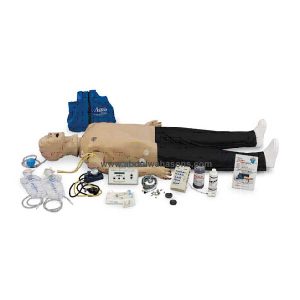
The Deluxe Adult CRiSis™ Manikin is a complete resuscitation system that presents challenges you may face in real world situations, with five major features allowing practice of several simulation scenarios. Each manikin consists of an “Airway Larry” Airway Management Trainer Head, Blood Pressure Arm, Defibrillation Chest Skin, full body CPR manikin, and IV Arm. Ideal for ACLS, paramedic, EMT, and nursing training at every level. The Deluxe Adult CRiSis™ Manikin also includes an Interactive ECG Simulator (LF03670U). This arrhythmia/pacing simulator recreates 17 adult heart rhythms and 17 pediatric rhythms. With an external pacer, you can simulate electronic capture. You can also simulate cardioversion with manual, semiautomatic, or automatic defibrillation. Modular components allow you to create a manikin to suit your needs.. No electronic connection for CPR Monitoring, Memory, or Printer units. Electronic Upgrade Kit (LF03440U) and hard carry case (LF03465U) are available separately.
A realistic simulator for student practice of pediatric patient care techniques. Features include articulating head, jaw, arms, and legs; eye irrigation; oral, nasal, and digital intubation; place OP/NP tubes; right/left main stem bronchi; place nasal and oral gastric tubes; suctioning; BVM; chest compression/rise; lavage/gavage; G-tube placement; stomas for ileostomy, colostomy, and suprapubic exercises; intraosseous infusion; IV arm with variable, palpable pulses; male/female catheterization; and placement of rectal suppositories.
A realistic simulator for student practice of pediatric patient care techniques. Features include articulating head, jaw, arms, and legs; eye irrigation; oral, nasal, and digital intubation; place OP/NP tubes; right/left main stem bronchi; place nasal and oral gastric tubes; suctioning; BVM; chest compression/rise; lavage/gavage; G-tube placement; stomas for ileostomy, colostomy, and suprapubic exercises; intraosseous infusion; IV arm with variable, palpable pulses; male/female catheterization; and placement of rectal suppositories.
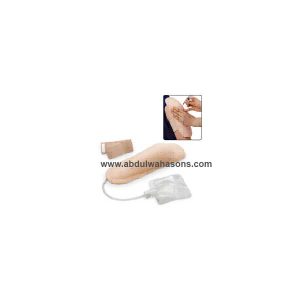
Learn the correct position for intramuscular injection by palpation. Straps to arm for practice. Simulator is light and compact. The special skin has no needle marks. Bones such as acromion enables training for palpation. Correct ot incorrect is indicated with built-in lamps and buzzer. Use with artificial injection fluid.
The Life/form® NG Tube & Trach Skills Simulator has been developed to aid with the instruction, training, and practice of vital tracheostomy skills and care for patients with respiratory conditions. The simulator is also designed for instruction of gastrointestinal care procedures through nasal and oral access. With a newly designed Life/form® head and torso, this simulator features realistic landmarks, trachea, esophagus, lungs, and stomach. For exceptional realism, methyl cellulose can be mixed with water to simulate mucous-like fluids of a real patient. Fluid can be added to the lungs and stomach for realistic tracheostomy care and suctioning. The simulator also allows for the practice of dressing changes and cuff inflation. Other realistic procedures include: NG tube care, including insertion, irrigation, and removal; gastric lavage and gavage; feeding tube insertion and removal with the ability to practice feeding; nasoenteric and esophageal tube care; oropharyngeal and nasopharyngeal care; and tracheostomy tube care Intubation using a laryngoscope blade and size 6.0 ET tube may also be practiced. The simulator is designed to use size 6 tracheostomy tubes (LF01170U) and a size 6 NG tube. Spray-pump lubricant, a packet of methyl cellulose, instruction manual, and hard carry case are included. The simulator does not include tracheostomy ET, or NG tube. 10″ D x 16″ W x 27 H.
An anatomically correct pelvic model with full term newborn and placenta to give your trainees realistic practice in multiple techniques, and to learn the procedure for emergency childbirth. Disposable umbilical cords with clamps, easily replaced extra vulva, powder to make simulated blood, a modular pregnant belly overlay with permanently installed fetus for training practice of Leopold’s maneuver to determine the fetus’ lie by palpating its skull and kneecaps, and a clear abdominal overlay to see positioning are all included. The lifelike pelvic cavity has pronounced pelvic landmarks, located spinal column, angled birth canal, ilium, ischium, sacrum, sacro spinous ligaments, and greater sciatic notch. The fetus provided is of a realistic newborn size with fontanels and cranial sutures. A soft carry bag is included. Size: 21″ x 13″ x 17″
Abdul Wahab & Sons provides advanced scientific and medical education solutions, including VR/AR, holograms, 3D Anatomy Tables, and PowerLab systems. AWS serve hospitals, research labs, medical schools, and universities with precision instruments, skill labs, and immersive learning tools empowering the future of healthcare and science.