
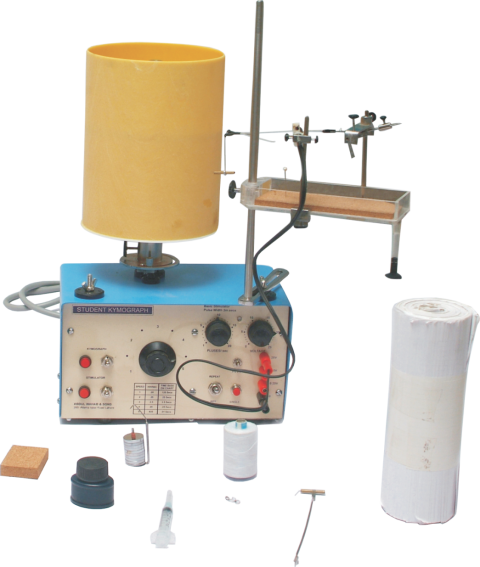
Description:
Explore the fascinating world of kymographs and their indispensable role in modern physiology. From muscle contractions to nerve impulses, discover how these simple yet powerful devices provide crucial insights into biological processes.
Introduction:
In the intricate dance of life, countless physiological processes unfold within our bodies every second. From the rhythmic beating of our hearts to the subtle contractions of our muscles, these events often involve movements and changes over time that are invisible to the naked eye. This is where the humble yet powerful kymograph steps in, offering a window into these unseen rhythms and revolutionizing how we study physiology. 🔬
What is a Kymograph?
At its core, a kymograph is a device that records movement or change over time. Imagine a rotating drum covered in a sheet of smoked paper or a digital screen displaying a moving graph. A stylus or a digital marker, connected to the physiological event being measured, traces a line on this surface, creating a visual representation of the changes occurring.
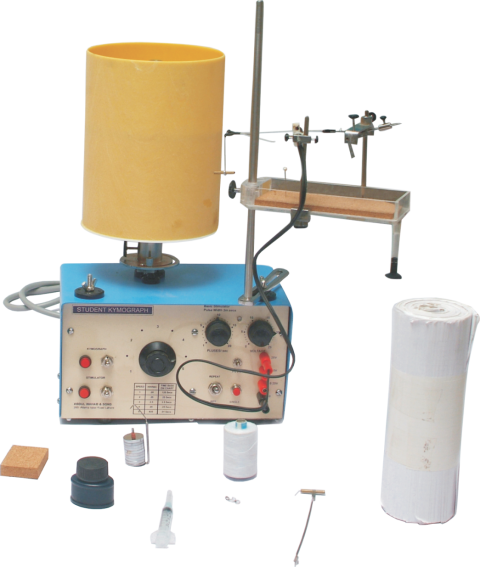
The term “kymograph” comes from Greek words: “kymos” meaning “wave” and “graphos” meaning “to write.” True to its name, it literally “writes waves” of physiological activity. 🌊
A Brief History: From Soot to Software
The kymograph was invented in 1847 by the German physiologist Carl Ludwig. His original design used a rotating drum covered in soot-blackened paper, with a stylus scratching away the soot to reveal the underlying white surface. This ingenious invention allowed scientists to record phenomena like blood pressure changes and muscle contractions with unprecedented accuracy.
Over the decades, kymographs evolved. Mechanical systems gave way to electronic ones, and smoked paper was replaced by pens on graph paper, then by digital sensors and computer software. Today, while the physical appearance has changed dramatically, the fundamental principle remains the same: capturing temporal physiological data. 💻
How Kymographs Work in Modern Physiology
Modern kymographs are often integrated into sophisticated data acquisition systems. Here’s a simplified look at how they contribute to various physiological experiments:
Muscle Contraction Studies:
Mechanism: A muscle is stimulated, and its contraction pulls on a transducer connected to the kymograph.