Tracheotomy Trainer
Product Description
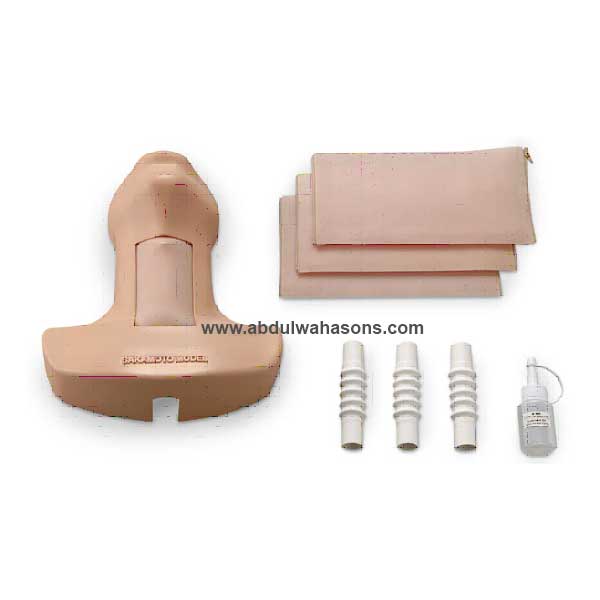
A practical trainer for various methods of tracheotomy. Training of both conventional and percutaneous tracheotomy and puncture/incision into the cricothyroid ligament is available. For conventional tracheotomy, different types of incisions can be performed including longitudinal, transverse, crucial, U-shaped, and inverted U-shaped. Simulating a patient in a supine position with the neck extended, the tracheotomy trainer allows the user to determine the proper incision site while identifying arterial locations, and to observe intratracheal conditions from the head. The trachea can be reused by turning it upside down or inside out, and the skin by sliding it to either side or turning it upside down. Contents: main body, neck (with arteries), thyroid cartilage (with cricoid cartilage), trachea (four pieces), skin (four sheets), and lubricant (silicon oil).
Related products
-
Auscultation Manikin with ECG Simulator
Product Description
Manikin has all the same features as the complete CRiSis™ Manikin (LF03953U with the addition of auscultation sites with heart and lung sounds, plus an ECG Simulator LF03670U). For auscultation training, the instructor selects from a menu of heart and lung conditions by wireless remote control. The manikin presents itself as a real patient without visible auscultation sites. The student must palpate to identify correct auscultation locations, and will hear different heart and lung sounds as the SmartScope™ is moved to different locations on the manikin. A diagnosis of the condition selected by the instructor can be made by comparing the variations in sounds occurring at different sites – just like a real patient! Lung sounds can be detected at five anterior and two midaxillary locations and students can practice auscultation at six anterior heart sites. The remote control does not have to be pointed directly at the manikin or SmartScope™ to operate. One remote control will operate multiple sets of SmartScopes™ and manikins simultaneously. Great for group instruction. Listen to the sounds by using either the single or dual user headpieces on SmartScope™ or by connecting to an amplified speaker (not included, see SB20146U). Range on the unit is up to 100 ft. of remote access. Adult CRiSis™ Auscultation Manikin includes Complete CRiSis™ Manikin with auscultation sites, one remote control with LCD display, one SmartScope™ with single- and dual-user headpieces, hard storage case, and ECG Simulator (LF03670U). Requires two “AA” and two “AAA” batteries (included).
Lung Conditions:
• Bronchial
• Bronchovesicular
• Cavernous
• Coarse Crackle
• Egophony
• Fine Crackle
• Friction Rub
• Infant
• Mono Wheeze
• Normal
• Normal Vesicular
• Pectoriloquy
• Pulmonary Edema
• Rhonchi
• Stridor
• WheezeHeart Conditions:
• Aortic Regurgitation
• Atrial Septal Defect
• Holosystolic
• Mid Systolic
• Mitral Stenosis
• Normal
• PDA
• Pulmonary Stenosis
• Systolic Click
• S3 and S4 Gallup
• VSD -
Code Simulator 12-Lead Arrhythmia Simulator – ZOLL
Pace and defibrillate directly into this interactive 12-lead ECG simulator through your hands-free defibrillation cable. Connects directly to monitor • Does not work with manikin • Simulate electrical capture with your external pacer. Press simulator capture key to select one of four preset pacing capture levels: 70, 80, 90, or 100mA. When pacer current is greater than selected capture level, paced beats appear on your monitor. Waveforms for pacing include: Sinus Brady (two), 1st degree A-V block, 2nd degree type I A-V block, 2nd degree type II A-V block, 2nd degree type II A-V block with PVCs, and 3rd degree A-V block. • Simulate cardioversion with your manual, semi-automatic, or automatic defibrillator. Activate “convert” feature to select - before defib discharge - another rhythm to run immediately after defib discharge. Waveforms for defibrillator training include: V. Fib., V. Tach (high rate), V. Tach (low rate), Torsade, A. Fib, A. Flutter, PSVT, Sinus Tach, Sinus Rhythm, Sinus Rhythm with PVCs, Asystole, and NSR. • Generate realistic 12-lead ECG rhythms. Connect your ECG cable to simulator’s 10 ECG snaps. Independent chest lead and limb lead ECG signals create realistic 12-lead ECGs for each rhythm. Generate ST segment and T wave abnormalities including: Anterior MI, Inferior MI, Antero-Septal ST Elevation, Anterior ST Depression, Lateral ST Elevation, and Inferior ST Elevation. • LED indicators: pacer pulse detection, defib discharge detection, and low battery.
-
AED Practi-Trainer – Bilingual
Product Description
This new and improved AED trainer with plug-in module has all the functions needed to teach students about AED operation – without breaking your equipment budget. This lightweight, value-priced trainer offers bilingual scenarios (English and Spanish), a fully functional remote control, volume adjustment and pause functions, adult and child connectors, and pads. Includes eight pre-programmed scenarios to simulate various cardiac arrest cases. Audible metronome paces CPR chest compressions. Audio port allows you to connect speakers so the entire class can hear scenarios as they play out – extending training even while they wait. Plug-in design allows for easy upgrades and language changes. Comes in a 10-1/2″ x 8″ x 2-3/4″ nylon carrying case. Base requires three “AA” batteries (not included). Remote control requires two “AAA” batteries (not included). AED trainer measures 7″ x 5-3/4″ x 2″. Meets 2005 ECC guidelines. against defects.
-
Peter PICC Line
Product Description
The only available teaching model which permits the practice of placing Peripherally Inserted Central Catheter Lines (PICC Lines). The rapid acceptance and use of PICC Lines creates a need to be able to properly teach this procedure. Peter PICC Line™ allows both the teaching and assessment of this insertion technique. This portable teaching model has translucent arm skin that allows the visualization of the anatomically correct cephalic, basilic, and median basilic veins. The axillary jugular, subclavian, and superior vena cava veins are also present, plus a movable chin simulates the occlusion of the jugular to prevent the PICC Line from taking this path. Palpable ribs permit practice in measuring proper catheter length to the correct intercostal space. The model also permits the measurement of catheter length outside of the body and the confirmation of proper placement by viewing the distal tip of the catheter in the viewable superior vena cava. Replaceable, barely translucent arm skin allows visualization of underlying veins. Includes soft carrying case. A great tool for training and skill assessment. Blue veins are made of natural latex. Measures 17″ x 22″ x 5-1.2″.

Reviews
There are no reviews yet.