AED Practi-Trainer – Bilingual
Product Description
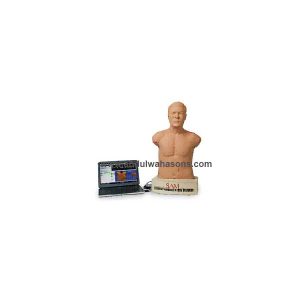
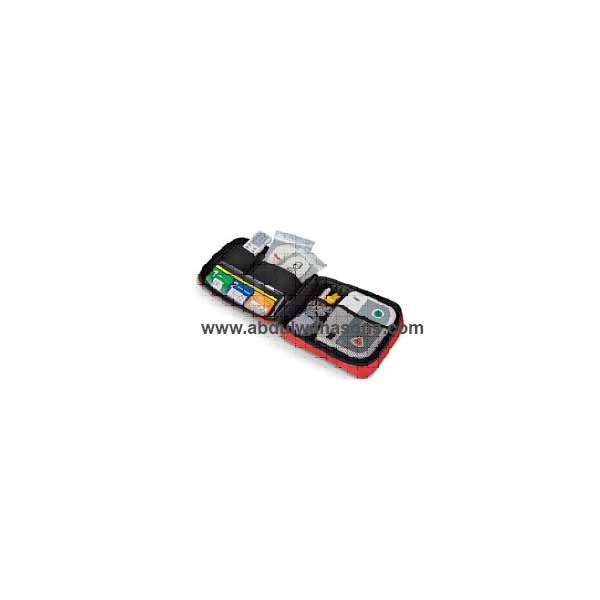
This new and improved AED trainer with plug-in module has all the functions needed to teach students about AED operation – without breaking your equipment budget. This lightweight, value-priced trainer offers bilingual scenarios (English and Spanish), a fully functional remote control, volume adjustment and pause functions, adult and child connectors, and pads. Includes eight pre-programmed scenarios to simulate various cardiac arrest cases. Audible metronome paces CPR chest compressions. Audio port allows you to connect speakers so the entire class can hear scenarios as they play out – extending training even while they wait. Plug-in design allows for easy upgrades and language changes. Comes in a 10-1/2″ x 8″ x 2-3/4″ nylon carrying case. Base requires three “AA” batteries (not included). Remote control requires two “AAA” batteries (not included). AED trainer measures 7″ x 5-3/4″ x 2″. Meets 2005 ECC guidelines. against defects.
Related products
-
Code Simulator 12-Lead Arrhythmia Simulator – Phillips
Product Description
Pace and defibrillate directly into this interactive 12-lead ECG simulator through your hands-free defibrillation cable.
• Simulate electrical capture with your external pacer. Press simulator capture key to select one of four pre-set pacing capture levels: 70, 80, 90, or 100mA. When pacer current is greater than selected capture level, paced beats appear on your monitor. Waveforms for pacing include: Sinus Brady (two), 1st degree A-V block, 2nd degree type I A-V block, 2nd degree type II A-V block, 2nd degree type II A-V block with PVCs, and 3rd degree A-V block.
• Simulate cardioversion with your manual, semi-automatic, or automatic defibrillator. Activate “convert” feature to select – before defib discharge – another rhythm to run immediately after defib discharge. Waveforms for defibrillator training include: V. Fib., V. Tach (high rate), V. Tach (low rate), Torsade, A. Fib, A. Flutter, PSVT, Sinus Tach, Sinus Rhythm, Sinus Rhythm with PVCs, Asystole, and NSR.
• Generate realistic 12-lead ECG rhythms. Connect your ECG cable to simulator’s 10 ECG snaps. Independent chest lead and limb lead ECG signals create realistic 12-lead ECGs for each rhythm. Generate ST segment and T wave abnormalities including: Anterior MI, Inferior MI, Antero-Septal ST Elevation, Anterior ST Depression, Lateral ST Elevation, and Inferior ST Elevation.
• LED indicators: pacer pulse detection, defib discharge detection, and low battery. -
NG Tube & Trach Skills Simulator
Product Description
The Life/form® NG Tube & Trach Skills Simulator has been developed to aid with the instruction, training, and practice of vital tracheostomy skills and care for patients with respiratory conditions. The simulator is also designed for instruction of gastrointestinal care procedures through nasal and oral access. With a newly designed Life/form® head and torso, this simulator features realistic landmarks, trachea, esophagus, lungs, and stomach. For exceptional realism, methyl cellulose can be mixed with water to simulate mucous-like fluids of a real patient. Fluid can be added to the lungs and stomach for realistic tracheostomy care and suctioning. The simulator also allows for the practice of dressing changes and cuff inflation. Other realistic procedures include: NG tube care, including insertion, irrigation, and removal; gastric lavage and gavage; feeding tube insertion and removal with the ability to practice feeding; nasoenteric and esophageal tube care; oropharyngeal and nasopharyngeal care; and tracheostomy tube care Intubation using a laryngoscope blade and size 6.0 ET tube may also be practiced. The simulator is designed to use size 6 tracheostomy tubes (LF01170U) and a size 6 NG tube. Spray-pump lubricant, a packet of methyl cellulose, instruction manual, and hard carry case are included. The simulator does not include tracheostomy ET, or NG tube. 10″ D x 16″ W x 27 H.
-
Advanced Venipuncture and Injection Arm – Light
Product Description
This revolutionary training arm provides complete venous access for IV therapy and phlebotomy, plus sites for intramuscular and intradermal injections. An extensive 8-line vascular system allows students to practice venipuncture at all primary and secondary locations, including starting IVs and introducing Over the Needle IV Catheters. The venous system simplifies setup with only one external fluid bag supplying artificial blood to all veins simultaneously. The dorsal surface of the hand includes injectable metacarpal, digital, and thumb veins. The antecubital fossa includes the median cephalic, median basilic, and median cubital veins. Venipuncture can also be performed along the basilic, cephalic, accessory cephalic, and median antebrachial veins. Intramuscular injections may be performed in the deltoid muscle and intradermal injection sites are located in the upper arm. Intramuscular injections into the deltoid muscle are enhanced by the soft, lifelike skin and by the natural bony landmarks in the region. Intradermal injections using distilled water will create characteristic skin welts at designated sites on the upper arm. The realism of the Life/form® Advanced Venipuncture and Injection Arm is truly amazing. The soft, flexible fingers are molded separately with extreme attention paid to every detail – right down to the fingerprints! Flexion of the wrist helps students develop manipulation skills. The replaceable skin rolls as the veins are palpated, and a discernable “pop” is felt when entering the veins. The Life/form® molding process reproduces the fine details of the skin to make the arm look and feel alive. Valves in the veins can be seen and palpated on the skin surface. Simulated veins and skin are completely replaceable to keep this training arm looking and working like new. Under normal use, hundreds of injections may be performed before the veins or skin need to be replaced. Complete replacement kits are available and easy to use. To extend the life of the veins, an aerosol sealant is available to seal punctures and prevent leakage.
Complete Venous Access:
• Basilic V.
• Cephalic V.
• Digital V.
• Dorsal Metacarpal V.
• Median Basilic V.
• Accessory Cephalic V.
• Extensive Venipuncture System
• Flexible Fingers and Wrist
• Intradermal Injections
• Intramuscular Injections
• Median Antebrachial V.
• Median Cephalic V.
• Median Cubital V.
• Replaceable Skin and Veins -
Peter PICC Line
Product Description
The only available teaching model which permits the practice of placing Peripherally Inserted Central Catheter Lines (PICC Lines). The rapid acceptance and use of PICC Lines creates a need to be able to properly teach this procedure. Peter PICC Line™ allows both the teaching and assessment of this insertion technique. This portable teaching model has translucent arm skin that allows the visualization of the anatomically correct cephalic, basilic, and median basilic veins. The axillary jugular, subclavian, and superior vena cava veins are also present, plus a movable chin simulates the occlusion of the jugular to prevent the PICC Line from taking this path. Palpable ribs permit practice in measuring proper catheter length to the correct intercostal space. The model also permits the measurement of catheter length outside of the body and the confirmation of proper placement by viewing the distal tip of the catheter in the viewable superior vena cava. Replaceable, barely translucent arm skin allows visualization of underlying veins. Includes soft carrying case. A great tool for training and skill assessment. Blue veins are made of natural latex. Measures 17″ x 22″ x 5-1.2″.

Reviews
There are no reviews yet.